Loading starfield...

Best Stargazing Locations in Czech Republic

Every site listed here has been visited and evaluated in person. Bortle class estimates are based on direct sky quality measurements and comparison with Light Pollution Map data. We note access conditions, altitude, horizon quality, and any facilities.

How Light Pollution Affects Your Observation

The Bortle scale runs from 1 (pristine dark sky, no artificial light visible anywhere) to 9 (inner-city sky where only the Moon and a few dozen stars are visible). Czech cities sit at Bortle 7–9. The countryside around small towns is typically Bortle 5–6. Protected natural parks and highland ridges above 700 metres can reach Bortle 3–4 under good conditions.

The practical difference between Bortle 5 and Bortle 3 is dramatic. At Bortle 5 you might see 2,000–3,000 stars with the naked eye and the Milky Way as a faint band. At Bortle 3 the naked-eye count exceeds 5,000, the Milky Way casts a visible shadow, and the Andromeda Galaxy is clear to the unaided eye. For serious deep-sky work with a telescope, anything better than Bortle 4 makes a significant difference.

Dark sky with Milky Way visible at Beskydy dark sky reserve

Dark Sky Beskydy — Gruň Ridge

Northern Moravia — Beskydy Mountains

The flagship dark sky site in the Czech Republic. Located at nearly 900 metres altitude on the Gruň ridge in the Beskydy protected landscape area, this is also the home of the country's largest publicly accessible astronomical telescope. Evening programmes run regularly from spring through autumn, led by trained astronomers. For independent observers, the surrounding meadows and forest tracks offer good horizon access in all directions. The nearest large light dome is Ostrava, approximately 35 km to the north, but the ridge itself is well shielded by terrain.

Altitude: ~900 m Bortle: 3–4 Best season: May–Oct
Pleiades star cluster visible from dark sky areas in Jizerske hory

Jizera Dark Sky Park — Jizerka Plateau

Northern Bohemia — Jizerske hory

One of the first officially recognised dark sky reserves in Central Europe and the most accessible dark sky area from Prague (approximately 90 minutes by car). The Jizerka plateau sits at around 900 metres and benefits from strict municipal lighting ordinances that have been in place since 2003 — one of the main reasons the area achieved and maintains its status. The plateau itself is largely open bog and meadow, giving excellent low-horizon views to the north and east. The village of Jizerka has a small public observation point with information boards.

Altitude: ~850 m Bortle: 3–4 Dist. from Prague: ~130 km
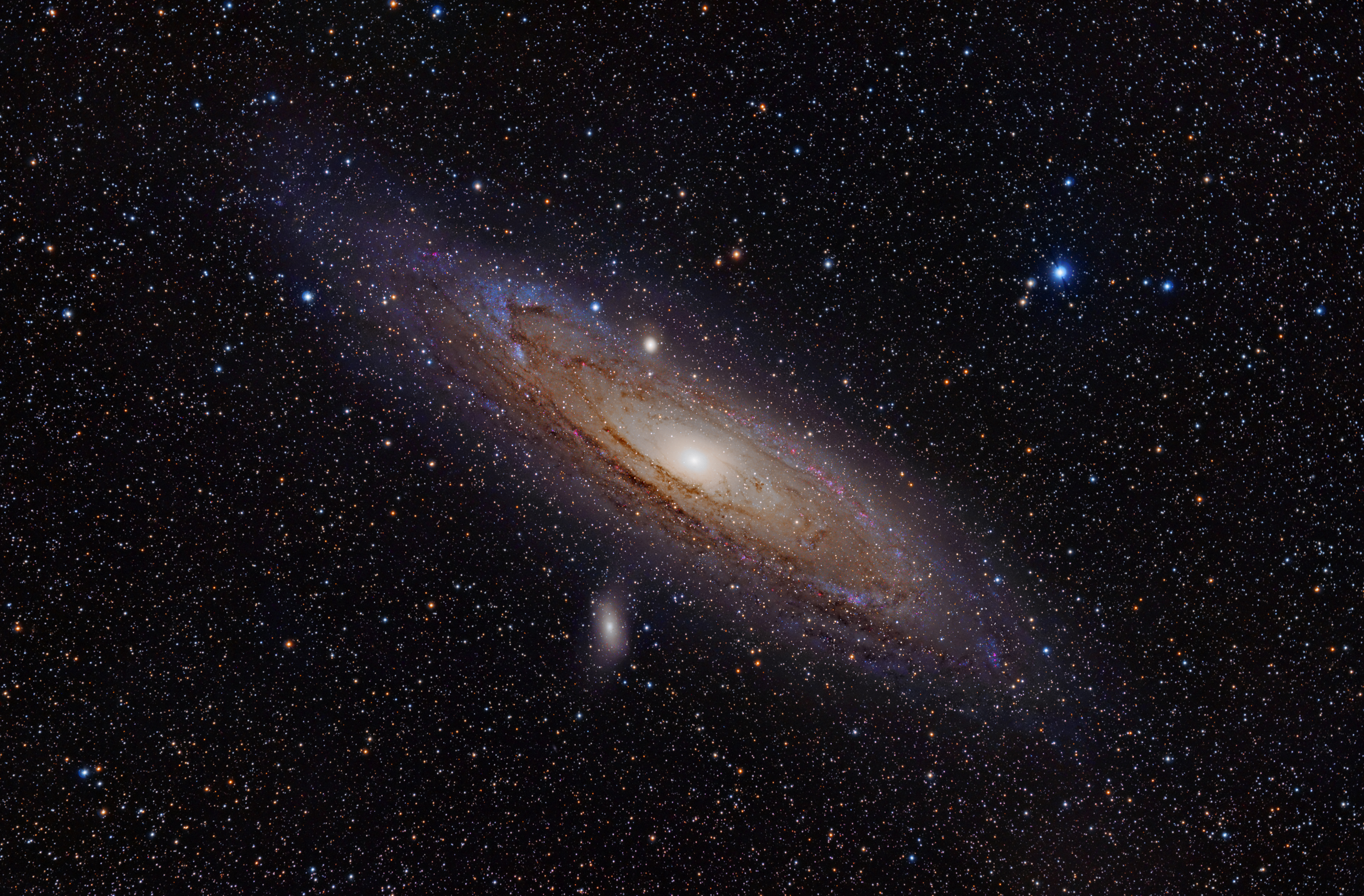
Andromeda Galaxy detail — the kind of view possible from Sumava dark sky sites

Sumava National Park — Southern Bohemia

Southern Bohemia — Sumava

The Sumava plateau stretches along the Czech-German border at elevations between 800 and 1,000 metres. The national park's strict zoning limits development, and many of the plateau meadows are remote enough to be genuinely dark. The region is particularly noted for its southward horizon — at this latitude (approximately 49°N), Sagittarius and the galactic core are low but visible on summer nights, and from a flat plateau you can follow the Milky Way from Cygnus overhead down to the southern horizon. Popular access points include the area around Modrava and the Kvilda plateau.

Altitude: 800–1,000 m Bortle: 3–4 Best season: Jun–Sep
Orion Nebula — visible from dark sky sites in Krusne hory range

Melchiorova Hut — Unešov

Western Bohemia — near Unešov

Designated as a dark sky location and the venue for the annual Dovolená s dalekohledem (Telescope Holiday) gathering of Czech amateur astronomers. The site sits at 587 metres in a quiet forested area. While the altitude is modest by Beskydy or Sumava standards, the low population density of the surrounding countryside keeps the sky genuinely dark. The site benefits from good east and south horizon access. The annual gathering includes expert workshops, group observations, and equipment lending — a practical way for beginners to try different telescope types before purchasing.

Altitude: 587 m Bortle: 4 Notable: Annual gathering
Saturn — excellent planetary target from Czech Republic observation sites

Bile Karpaty — White Carpathians

South Moravia — Bile Karpaty

The Bile Karpaty protected landscape area along the Slovak border offers some of the darkest skies in Moravia outside the Beskydy. Rolling pastoral hills with few villages mean minimal light scatter, and the elevated ridge sections give wide horizon views. This area is significantly less visited by astronomers than Beskydy, which means you will often have a meadow entirely to yourself on a clear night. The area around Lopeník (912 m, the highest point of the range) is particularly recommended. Access requires a car and familiarity with forest tracks.

Altitude: up to 912 m Bortle: 3–4 Access: Car required
Jupiter detail — bright planets visible even from Bortle 5 suburban sites

Štefánik Observatory — Prague

Prague 1 — Petrin Hill

Included here not as a dark sky site — it sits at Bortle 8–9 in the heart of Prague — but as the most accessible public observatory in the country and the best option for beginners who cannot travel. Founded in 1928 and perched on Petrin Hill with a view of the city, the observatory runs regular public evenings with guided views through its historic 20cm refractor. Planets, the Moon, and bright double stars are the standard targets. The observatory staff are knowledgeable and accustomed to complete beginners. For anyone curious about astronomy before committing to equipment, this is the logical first step.

Type: Public observatory Bortle: 8–9 Access: Tram + funicular

Practical Tips for Czech Stargazing

Checking the Forecast

Cloud cover is the primary obstacle in Central Europe, not light pollution. The Meteoblue seeing forecast provides astronomical seeing conditions (atmospheric turbulence affecting image sharpness) as well as cloud cover, which is more useful for observers than a standard weather forecast. Clear Outside (available as a free app) gives a combined cloud, seeing, and transparency forecast that experienced Czech observers consider reliable.

Dark Adaptation

Your eyes require approximately twenty to thirty minutes to reach full dark adaptation after exposure to white light. Use a red flashlight for charts and equipment handling — red light preserves night vision in a way that white or blue light does not. Mobile phone screens, even at minimum brightness, reset your adaptation instantly.

When to Go

Moonless periods around new moon are the prime windows for deep-sky observing. The summer months of July and August combine long evenings, high Milky Way altitude, and the Perseid meteor shower. Winter brings the Orion nebula and other targets near the celestial equator to excellent positions, but cold temperatures require proper insulation — at 900 metres in January, temperatures regularly drop to -10°C or below.